The Seven-Headed Hydra: An Epic Guide to Financial Survival
Hey beautiful people. Felix Mason here.
At NoctisCorvus, we make spaces for the soul — whether that's the soft, melodic chime of our hand-tuned wind chimes or the quiet, grounding life inside one of our glass terrariums. But let's pause for a moment of radical, slightly uncomfortable honesty. You can burn all the palo santo in the world, sit with your breath, and practice mindfulness until you're levitating off your cushion, and you still will not be able to meditate your way out of a debt carrying a crushing 60% APR.
Real peace isn't only about breathing exercises; it's about taking active, relentless control of your own direction. And few things drain your family's long-term wealth — and your day-to-day calm — like the slow grind of never-ending credit card debt.
The Plastic Trap
Let's talk numbers. In the United States, the average credit card interest rate currently hovers around a painful 25%. In Canada, we're looking at rates near 21%. And these are supposedly well-developed markets.
Elsewhere, the picture gets frankly predatory. In countries like Mexico, cards from traditional financial institutions can carry APRs anywhere from 40% to 80%, while in my beloved Dominican Republic, credit card rates average a staggering 60%. And believe it or not, it was considerably worse a few years ago.
The common thread is that in every country on earth, credit cards carry the highest interest rates on the market.
Descartes famously said, "I think, therefore I am." The modern credit card industry says: "You swipe, therefore you're ours."
Karl Marx wrote at length about the alienation of labor. He argued that under capitalism, the nature of work changes — from a creative, satisfying human activity into a source of dehumanization and distance. But honestly? There's no modern alienation quite like working forty-plus hours a week and handing your paycheck to a bank to cover a vacation you took three years ago. When you finance your life on a card, you're not just borrowing money; you're selling your future peace of mind to a system designed to keep you on the hamster wheel.
The Hard Math of Forever Debt
Let's walk through a real-world scenario to see exactly how this compounds. Say you're carrying a $7,000 balance split across two high-rate credit cards:
- The U.S. card: A North American credit card with a $3,500 balance at 25% APR. If you make only the minimum payment, you'll be making monthly payments for more than a decade. That's a function of how the U.S. minimum-payment formula works. Under that structure, your early payments go mostly toward accrued interest, which means by the time you're done, you've paid roughly $3,500 extra in finance charges alone — effectively doubling the cost of your original purchases. This "minimum payment trap" doesn't just erode your money through compound interest; it also keeps your credit utilization high, which works against your financial health over the medium and long term.
- The Dominican card: The Dominican minimum-payment model — based on one thirty-sixth of the principal — creates a deceptive trap. The monthly payment shrinks a little each month, but it does so by stretching the debt cycle out indefinitely. At 60% annual interest, that structure sends most of your money toward interest, pushing the total cost of the debt to more than double the original amount over a period of ten years. Yes, you read that right: a decade of monthly payments. The minimum payment is designed to maximize the timeline. As a result, the total interest paid ends up exceeding the original balance you spent before the debt is even cleared.
What this shows is that at high rates, the minimum payment is not your ally. It's a mechanism that perpetuates debt, turning small purchases into lifelong commitments.
The Seven-Headed Hydra
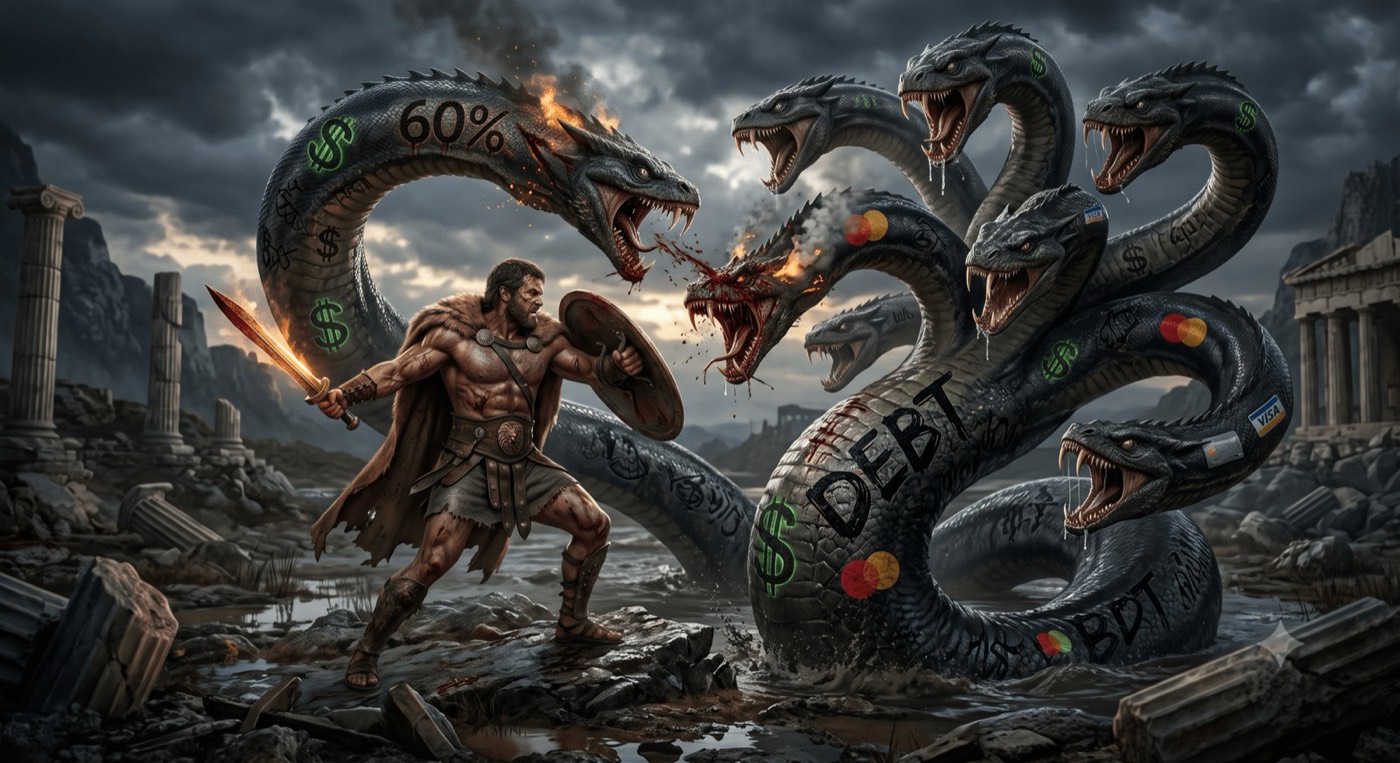
To understand how to beat this, we need to look at one of the twelve labors of Hercules: his battle with the Hydra of Lerna.
Hercules, in all his demigod glory, figured he could beat the beast with brute force. He grabbed his sword and lopped off one of its heads. And then? Boom. Two furious new heads sprouted instantly from the stump. The more he cut, the more grew back.
That, my fellow peace-seekers, is exactly what happens when you try to pay down a 60% interest debt with minimum payments while still using those same cards for your daily spending. You think you're attacking the problem — slicing off a head with your $50 a month — but by the next statement, the interest monster has sprouted two new heads of debt. This isn't bad luck. It's a creature mathematically engineered to feed on your wealth. You can't simply wish it away; the Hydra runs on good intentions.
Back to our hero. Hercules realized brute force was useless and that he needed a strategy. He called on his nephew Iolaus, who stood by with a torch and cauterized each neck the instant it was cut — making sure the heads could never grow back.
Here's how we light the torch, take back our power, and finish the beast off today:
- The Killing Blow (cut the head off): If you have savings to clear the balance in full right now without going hungry or missing rent, do it. The return on wiping out a 60% interest rate is, literally, 60%.
- The Strategic Sword (refinancing): If paying it off in one swing isn't possible, change weapons. Visit your bank or credit union and ask about a personal loan to consolidate all your card balances. A standard personal loan might land somewhere in the 12% to 19% range, depending on your market. That immediately stops the worst of the bleeding and keeps the beast from multiplying.
- The Torch of Iolaus (cauterize the neck): Whichever route you take — refinancing or paying in full — you have to make one non-negotiable commitment to seal the wound: close the credit cards you just paid off, immediately. Don't leave them open "just in case" or "for emergencies." Call the bank, close the accounts, and physically cut that plastic in half.
Congratulations. You've slain the Hydra.
A New Dawn: The Debit Card Commitment
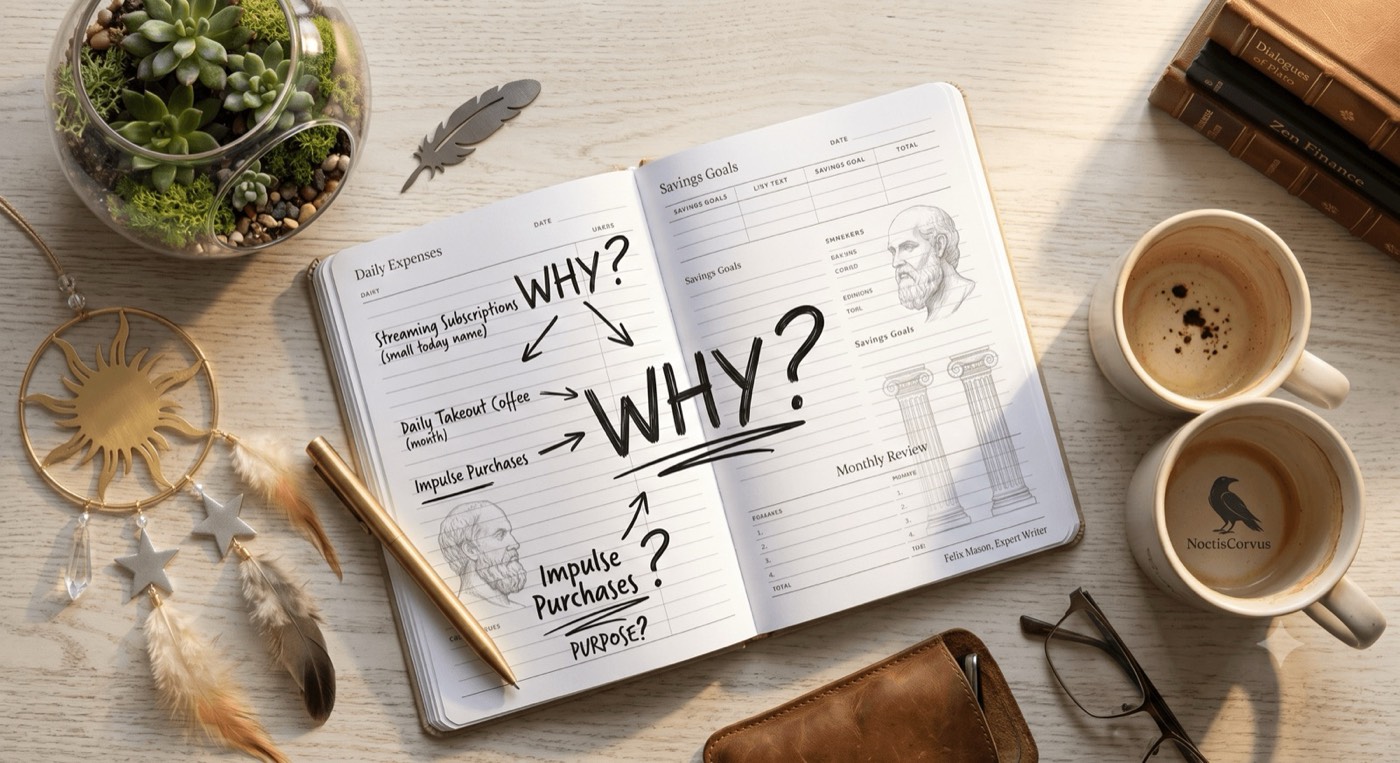
Starting today, I want you to commit to a practice. For the next 60 days, use only your debit card for every purchase. Think of it as a credit card detox.
Why debit, and why 60 days? When you use a debit card, you're spending money that's actually in your account, and you feel the real weight of the transaction. You're not borrowing against a future that doesn't exist yet; you're spending energy and time you've already earned, here in the present. The "buy now, pay later" mindset disappears. It's a mindfulness exercise: it anchors you in the now, which — as Zen Buddhism reminds us — is exactly where our freedom lives. And 60 days gives the new habit enough runway to actually take root.
Real mindfulness is recognizing that every dollar or peso you keep is a brick in the foundation of your future and your family's. Generational wealth isn't just about making millions; it's about fiercely protecting what you already have from the people who'd rather drain your joy through fees and finance charges. Take a deep breath. Look at your balances. Forgive yourself for past swipes, draw up the plan, and start a new chapter today.
Be at peace.